


A teenager with epilepsy needs surgery to change his destiny
Eighteen-year-old Lew Wen Di from Ipoh has been battling epilepsy since he was just two years old. Despite taking medication for years to control his condition, his epilepsy has worsened significantly in recent years. His seizures have become increasingly frequent, occurring almost every day at their worst. He now urgently needs RM120,000 to cover the cost of surgery and medical treatment, giving him a chance to regain his health and live a normal life.
Description
Eighteen-year-old Lew Wen Di from Ipoh has been battling epilepsy since he was just two years old. Despite taking medication for years to control his condition, his epilepsy has worsened significantly in recent years. His seizures have become increasingly frequent, occurring almost every day at their worst. He now urgently needs RM120,000 to cover the cost of surgery and medical treatment, giving him a chance to regain his health and live a normal life.
His single mother, Liew Yoke Fong, recalled that her son’s first seizure occurred shortly after she had started working. At that time, Wen Du was staying with relatives while she worked. One day, she received an urgent call informing her that he was convulsing uncontrollably. His eyes had turned red, his jaw was tightly clenched, and his right arm was jerking repeatedly.
“At that time, I had no idea he was having an epileptic seizure. In panic, I even put my hand into his mouth for him to bite before rushing him to a clinic.”
“When we arrived at the clinic, the doctor explained that he was experiencing an epileptic seizure. That was when I learned that you should never put your hand or any object into the mouth of someone having a seizure. I was heartbroken and terrified.”
The doctor advised her that whenever Wen Di experiences a seizure, he should be placed on his side to allow saliva to drain naturally, with a pillow placed under his head to prevent injury. Nothing should be inserted into his mouth, and if the seizure lasts longer than three to five minutes without him regaining consciousness, an ambulance should be called immediately or he should be rushed to the hospital.
She shared that during his childhood, Wen Di’s seizures were usually triggered by fever, flu, or illness, with each episode lasting around three to five minutes. Thanks to long-term medication, the duration of each seizure has been reduced to about 30 seconds to one minute. However, he still experiences stiffness and jerking on the right side of his body, clenched teeth, rolled-back eyes, excessive drooling, and sometimes foaming at the mouth. After every seizure, he is left extremely weak and exhausted.
Liew revealed that she separated from her husband when Wen Di was just over one year old and has raised him alone ever since. As relatives were afraid they would not know how to care for a child with frequent seizures, she eventually brought him to the mobile phone shop run by family members, where she worked while looking after him. She even prepared a bed in the shop so she could stay close whenever he developed a fever or felt unwell.
“From the age of two to eleven, his seizures mostly happened only when he had a fever, sometimes once a month. After he turned eight, his condition improved significantly, and he even went two consecutive years without a seizure. The doctors eventually stopped his medication, and I truly believed he had recovered.”
“However, during the COVID-19 Movement Control Order (MCO), he spent long hours using his mobile phone and computer for online classes. After schools reopened and he entered Form Two, he suddenly suffered another seizure while taking a nap at my workplace, causing his right hand to slam hard against a wooden wall. That marked the return of his epilepsy.”
Since the relapse, his seizures have become much more frequent, occurring three to four times a week and, during severe periods, even for five consecutive days. Sometimes, while the family is happily having a meal together, he suddenly vomits the food he has just eaten before collapsing into another seizure.
Liew said that living with a child who has epilepsy means she worries every single day. Her greatest fear is that he may suddenly collapse and injure himself or experience a seizure while sleeping. A fall causing a head injury or accidental suffocation beneath a pillow could have devastating consequences.
Even while working, she can never truly relax. She installed CCTV cameras at home, although her workplace is only about ten minutes away. She constantly checks the live footage on her phone, and whenever she notices anything unusual, she immediately rushes home.
Regarding his diet, she carefully avoids letting him consume fried food, spicy food, cold beverages, coffee, or alcohol. However, after Wen Di started working two months ago, he secretly bought fried chicken and iced drinks, tempted by Ipoh’s famous food. Shortly afterwards, his condition deteriorated dramatically, with seizures occurring almost every day.
She also shared that a relative once told Wen Di that he did not need to seek his mother’s permission for everything and could simply buy whatever food he wanted. Since then, he has stopped consulting her about his diet, making it much harder for her to manage his condition.
Living with epilepsy for so many years has also affected Wen Di emotionally. He has become deeply self-conscious and withdrawn. Since childhood, he has been afraid of going out and making friends. After every seizure, he prefers to hide, unwilling for others to know about his illness.
“I always tell him not to hide. What if he collapses and no one knows? At the very least, his teachers and classmates should understand his condition so they can help him immediately if something happens.”
During primary school, she frequently requested medical leave for him because she was worried about his seizures, and his teachers paid special attention to his health. After entering secondary school, parents were required to declare students’ medical conditions, while the hospital also provided official medical reports to help the school better understand his situation.
She recalled that Wen Du had experienced seizures during class. Since he would simply lower his head with slight hand movements, it was often only the classmates sitting beside him who noticed something was wrong and alerted the teachers. Sometimes, after a seizure, he would spit out saliva or vomit the food he had eaten, rest briefly, and then continue attending lessons. If he developed a headache, he would call his mother to fetch him home.
“There was once when I stayed by his bedside for three days and three nights without daring to sleep. Even now that he is older and sleeps in a separate room, I still wake up every two hours to check on him.”
“But now that he has grown up, he doesn’t always listen to me. Sometimes he even locks his bedroom door. If he has a seizure during the night, I may not even know.”
Liew acknowledged that although the medication provided by the hospital has helped reduce the severity of his seizures, it has never been able to fully control the condition. There are still days when he suffers one or two seizures.
Reflecting on the years of hardship, she said that besides caring for her son, she has also been looking after her mother, who suffers from dementia. The burden on her shoulders has never eased.
“My greatest wish is for my son to undergo the surgery successfully, recover, find a job he truly enjoys, and have a future of his own.”
“If one day he can live independently, I will finally be able to put down the burden in my heart. As long as he is still sick, I can never truly stop worrying. I only hope the surgery will be successful and allow him to fulfil his dreams.”
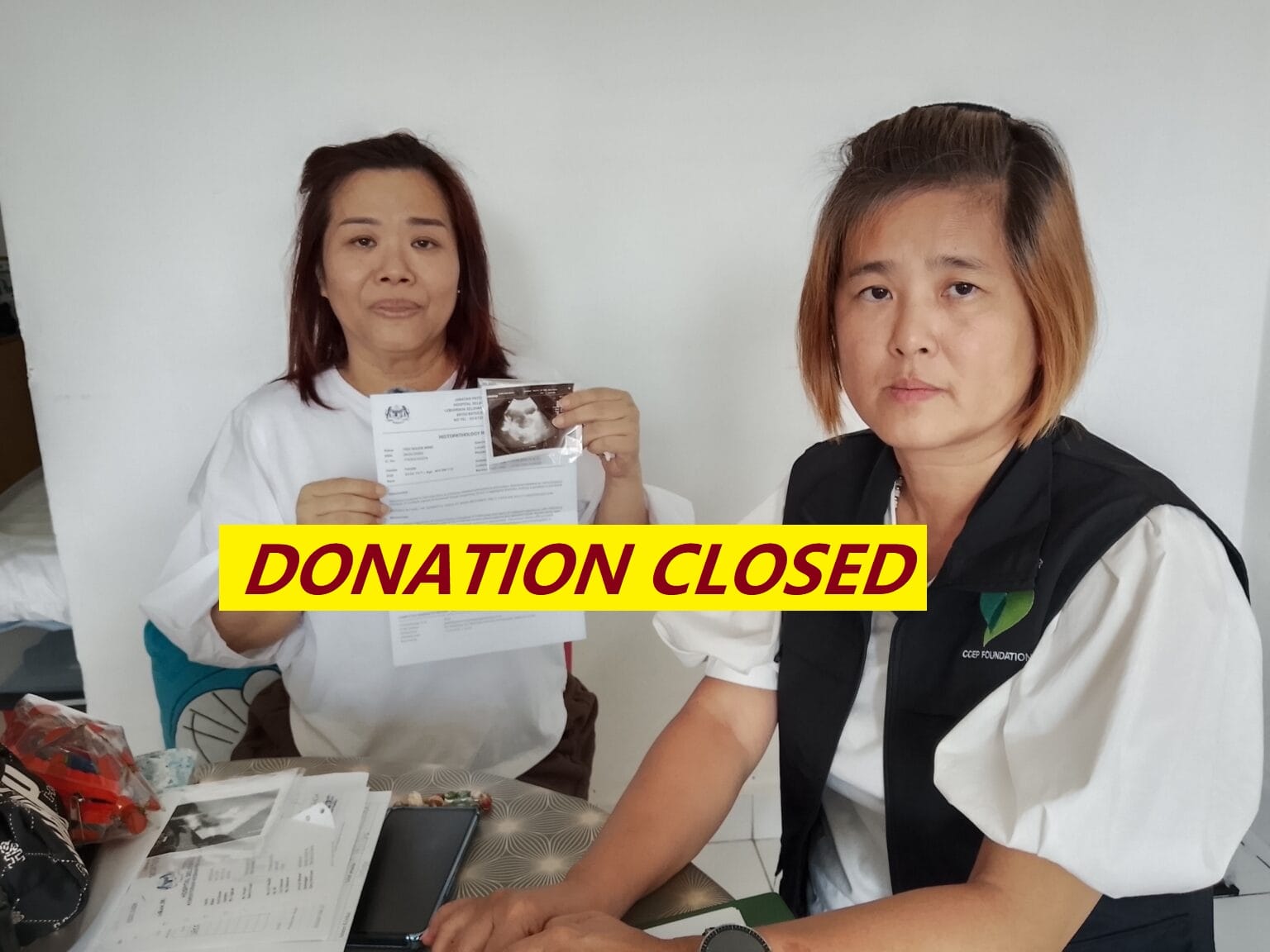
CCEP Foundation Chief Executive Officer, Yvonne Yee, said that according to the medical report provided by the hospital, Lew Wen Di does not have any learning disabilities. However, since being diagnosed with epilepsy at the age of two, his condition has never been effectively controlled.
“The medical report states that before each seizure, Wen Di experiences an abnormal sensation in his head, known as an aura. This is followed by a gradual loss of strength, causing him to collapse, before developing abnormal muscle stiffness on the right side of his body and involuntary turning of his head towards the left.”
“Despite trying multiple anti-epileptic medications over the years, he has continued to experience an average of one to two seizures every month since the onset of his illness.”
Yvonne explained that in 2025, Wen Di underwent a prolonged video electroencephalogram (EEG) monitoring assessment at Hospital Ipoh. Later that year, he was referred to the University of Malaya Medical Centre (UMMC) for further evaluation to determine whether he was a suitable candidate for epilepsy surgery.
According to the medical team, a comprehensive review of his 48-hour video EEG monitoring, brain MRI, and functional MRI (fMRI) for language mapping confirmed that his seizures originate from the left parietal lobe, where an abnormality was also identified on the MRI scan.
“He now requires stereo electroencephalography (SEEG), a minimally invasive neurosurgical procedure specifically used to precisely locate the seizure focus in patients with drug-resistant epilepsy.”
“This procedure enables neurosurgeons to accurately identify the exact area of the brain responsible for triggering the seizures. Without SEEG, a much larger portion of brain tissue might need to be removed during surgery. It also helps determine whether the abnormal area seen on the MRI involves nearby brain regions responsible for essential functions, particularly movement, thereby reducing the risk of serious postoperative complications such as paralysis.”
“We sincerely hope that after completing the surgery, Wen Di will become completely seizure-free. If his epilepsy can be successfully controlled, he will have the opportunity to secure stable employment, pursue an independent future, and enjoy a significantly improved quality of life,” she added.